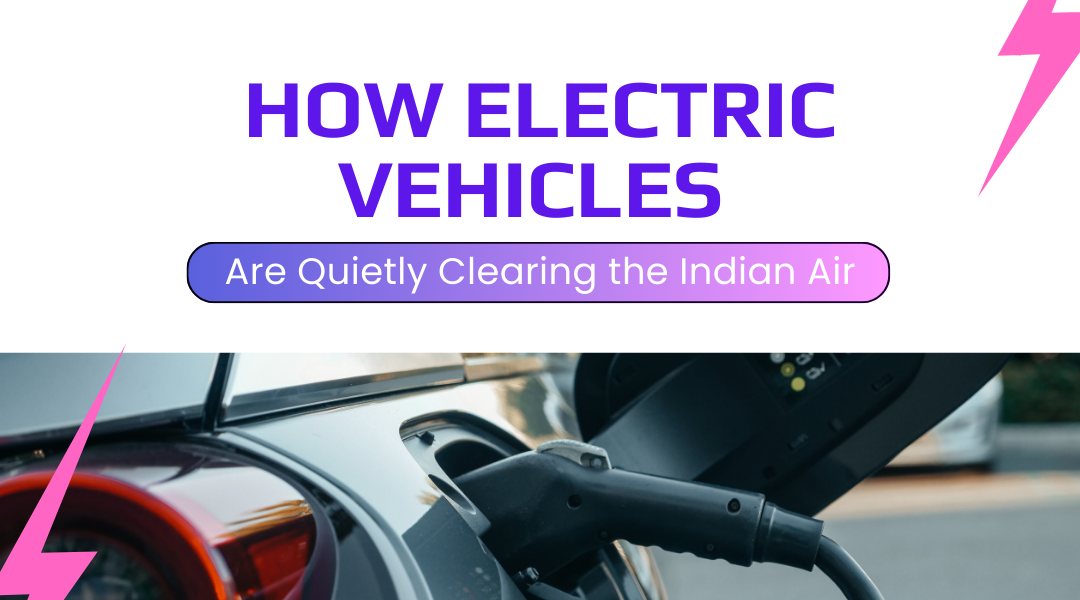
There is a new sound emerging in the cacophony of Indian cities. Beneath the persistent honking and the rumble of diesel generators, a new, quieter hum is growing—the sound of electric vehicles (EVs) in motion. This isn’t just an acoustic shift; it is the auditory signature of a profound environmental transformation. For decades, our urban landscapes have been suffocating under a visible blanket of smog and an invisible cocktail of toxic emissions, largely pumped out by the millions of internal combustion engines crowding our streets.
The transition to electric mobility is often discussed in terms of technology, policy, and economics. But its most profound impact is being felt in the very medium we all share: the air we breathe. This is the story of a great unburdening—a gradual, yet decisive, lifting of the pollution load from our atmosphere, one silent kilometer at a time.
The Direct Impact: A Tale of the Disappearing Tailpipe
The most immediate and obvious benefit of an EV is the complete elimination of tailpipe emissions. This single change has a cascading effect on urban air quality.
1. Banishing the Classic Pollutants:
A conventional vehicle is a mobile chemical plant, emitting a hazardous brew of gases and particles.
- Nitrogen Oxides (NOx): These are primary contributors to the brownish haze that often shrouds our cities. They irritate the airways, aggravate respiratory diseases like asthma, and are key ingredients in the formation of ground-level ozone and particulate matter.
- Particulate Matter (PM): Especially PM2.5—microscopic particles smaller than 2.5 micrometers—are a silent killer. Emitted directly from diesel engines and through the wear of tyres and brakes, these particles are small enough to enter the bloodstream via the lungs, leading to a host of cardiovascular and respiratory illnesses, cancers, and cognitive impairments.
- Carbon Monoxide (CO): This odourless, poisonous gas reduces the blood’s ability to carry oxygen, with severe consequences for those with heart conditions.
When an electric vehicle glides down the street, it emits precisely none of these pollutants. The replacement of a single, high-use commercial vehicle—like a delivery van or an auto-rickshaw—with an electric equivalent can have the pollution-reduction impact of taking multiple personal cars off the road. In cities like Delhi, Mumbai, and Bangalore, where the commercial vehicle fleet is a major emission source, the electrification of these workhorses is already creating localized “clean air zones.”
2. The Subtle Benefit of Reduced Noise Pollution:
While not a “pollutant” in the traditional sense, noise pollution is a significant environmental stressor. The constant drone of engines raises cortisol levels, contributes to hypertension, and diminishes the quality of urban life. EVs, with their near-silent operation at low speeds, are dramatically quieter. This creates a more peaceful and less stressful soundscape, making cities more livable. The difference is most palpable in residential areas and crowded market streets, where the dominant sound is shifting from engine roar to human activity.
The Systemic Shift: Ripple Effects Across the Energy Chain
The environmental argument against EVs often hinges on a single question: “Aren’t you just shifting the pollution from the car to a coal-fired power plant?” While a valid concern, this perspective is overly simplistic and ignores the dynamic nature of India’s energy landscape and the inherent efficiencies of the EV system.
1. The Centralized Efficiency Advantage:
Even when charged from a grid that includes coal power, an EV is fundamentally more efficient than a petrol or diesel vehicle. A traditional car’s engine is a marvel of mechanical complexity, but it is thermally inefficient; a vast majority of the energy stored in petrol is lost as waste heat. In contrast, a power plant, while polluting, converts fuel to energy more efficiently. Furthermore, electric motors are exceptionally efficient at converting electrical energy into motion (around 85-90% compared to 20-30% for internal combustion engines).
This means that for the same amount of primary energy, an EV will travel significantly farther. When you add in the energy lost in refining crude oil into petrol and diesel and transporting it to fuel stations, the “well-to-wheel” efficiency of an EV is substantially superior. It is a case of doing more with less, even with a non-green grid.
2. The Greening Grid Multiplier Effect:
This is where the true potential of EVs is unlocked. India is on a rapid trajectory to decarbonize its electricity grid. The country has set ambitious targets for renewable energy, with massive investments in solar parks, wind farms, and large-scale hydropower. As the share of renewables in the grid increases, the carbon footprint of every kilometer driven by an EV shrinks automatically.
An electric vehicle purchased today becomes cleaner every year as the grid gets greener. This is a feature no petrol car can ever offer. This synergy creates a virtuous cycle: the demand for electricity from EVs can be strategically managed through smart charging to absorb excess renewable energy during off-peak hours (like midday solar surplus), thereby supporting grid stability and making renewable investments more viable.
The Unseen Benefits: A Broader Environmental Healing
The positive impact of EVs extends beyond just urban air quality.
1. Curbing the Carbon Footprint:
Transportation is a major contributor to India’s greenhouse gas emissions. By transitioning to a progressively cleaner electricity-based system, EVs are a critical tool in the nation’s strategy to meet its climate commitments under the Paris Agreement. This shift is essential for mitigating long-term global warming and its associated impacts, such as extreme weather events.
2. Reducing Urban Heat Island Effect:
Cities are often several degrees hotter than their surrounding rural areas—a phenomenon known as the Urban Heat Island effect. A contributor to this is the waste heat generated by millions of engines and air conditioning units. By eliminating engine heat, EVs slightly reduce this thermal load, contributing to a marginally cooler microclimate.
3. The Potential for Cleaner Surroundings:
While brake and tyre dust remain, the absence of soot, oil leaks, and the spillage of fossil fuels from ICEs leads to cleaner roads and less contamination of soil and water sources.
The Ground-Level Reality: A Glimpse into a Clearing Future
The theory is solid, but what does this mean on the ground? The transformation, while in its early stages, is tangible.
- Case of the Electric Auto-Rickshaw: In cities, the shift from sputtering, smoke-belching two-stroke autos to electric versions is a visual and olfactory victory. The air at traffic junctions, once thick with noxious fumes, is becoming easier to breathe for commuters, traffic police, and street vendors alike.
- Last-Mile Delivery Vans: E-commerce and logistics companies are rapidly electrifying their delivery fleets. This means that the van stopping and starting repeatedly in your neighbourhood, which would have traditionally been idling and emitting, now operates cleanly and quietly.
- Public Transport Electrification: The introduction of electric buses is perhaps the most significant public health intervention. A single electric bus replaces a diesel bus that emits particulate matter equivalent to dozens of personal cars, providing clean transit for dozens of passengers simultaneously.
Conclusion: A Collective Breath of Fresh Air
The journey to clear the air in India’s cities is a marathon, not a sprint. Electric vehicles are not a magical silver bullet that will solve the pollution crisis overnight. They must be part of a broader strategy that includes robust public transport, pedestrian-friendly infrastructure, and waste management.
However, they represent the most direct and scalable technological intervention available to us today. Every electric vehicle on the road is more than just a mode of transport; it is a mobile air purification unit for the city. It represents a reduction in hospital visits for asthma attacks, a decrease in premature deaths, and a step towards reclaiming the simple, fundamental human right to breathe clean air.
The quiet hum of the EV is more than just the sound of advanced engineering; it is the sound of respite. It is the sound of a future where a child looking out at a city street sees a clear horizon, and takes a deep, healthy breath—a future that is slowly, but surely, being unburdened.